Published on: 4 October, 2025
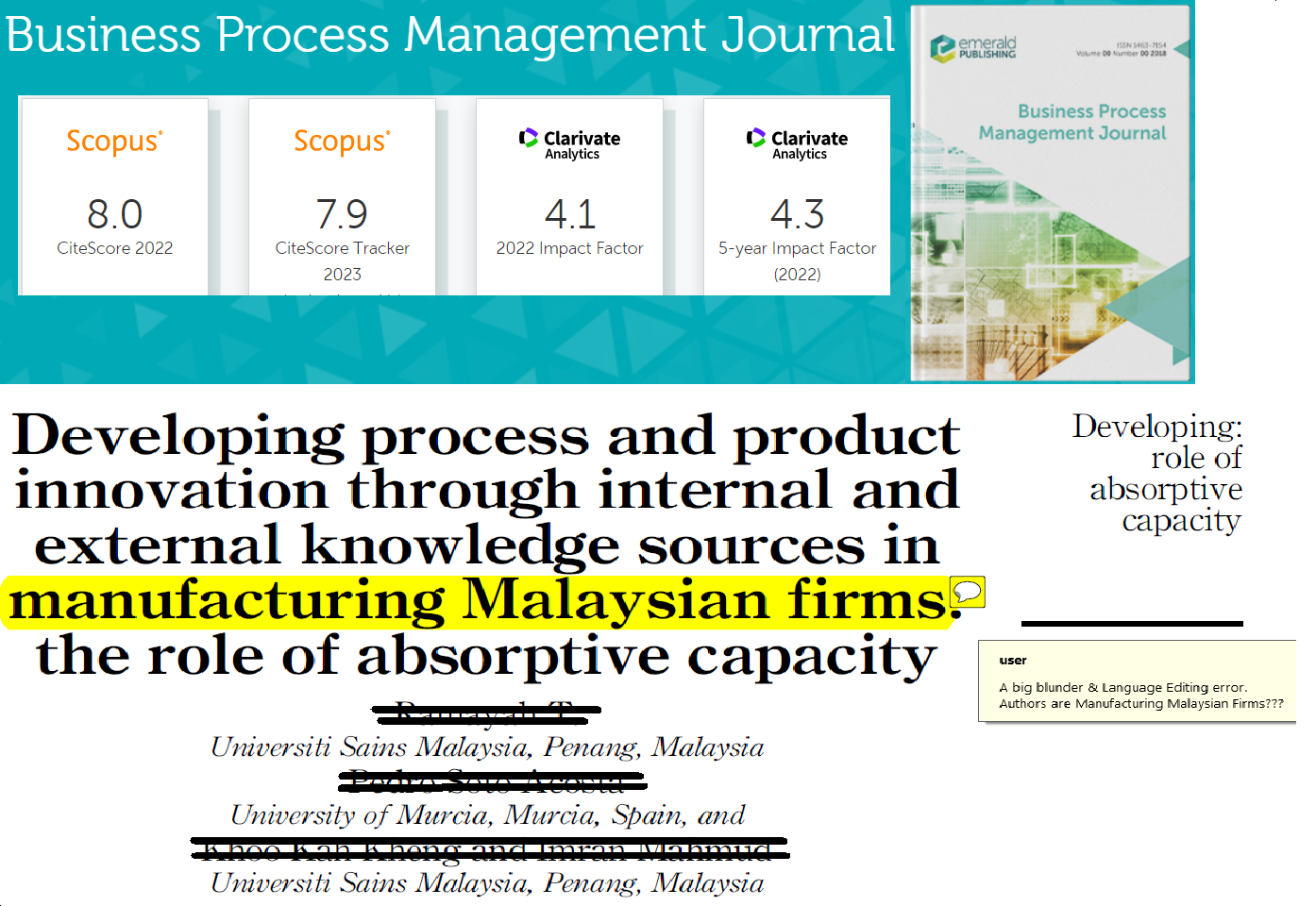
Today, we shall analyze the article "Human-centric BPM: employee exploitation effects on knowledge sharing behavior and CWB: a dual path model and its consequences" published in Business Process Management Journal (SSCI Impact Factor 2025: 5.8; Scopus Q1). This article raises several significant theoretical and methodological flags overlooked by editors and reviewers of the journal.

Based on the abstract and core findings, we present the detailed theoretical, methodological, and analytical issues with this study:
In the abstract, the authors mention in sub-section “Findings” (p. 1207):
"The other path suggested the insignificant role of optimism as a moderator in the relationship between employee exploitation and psychological empowerment. However, psychological empowerment fully mediates the relationship between employee exploitation and knowledge-sharing behavior."

In the whole paper, psychological empowerment was neither discussed nor included in the study framework. In fact, the construct that fully mediates the relationship between employee exploitation and knowledge-sharing behavior is psychological ownership. Psychological empowerment and psychological ownership are distinct constructs; empowerment involves the perception of competence, meaning, choice, and impact in one's work role, while ownership is the feeling that a target (e.g., a job or organization) is "MINE!" What a blunder the authors, editors, and reviewers have committed!
The most glaring theoretical issue lies in the proposed mediation pathway (first mediation chain; p. 1213, Figure 1):
Employee Exploitation → Psychological Ownership → Knowledge Sharing Behavior
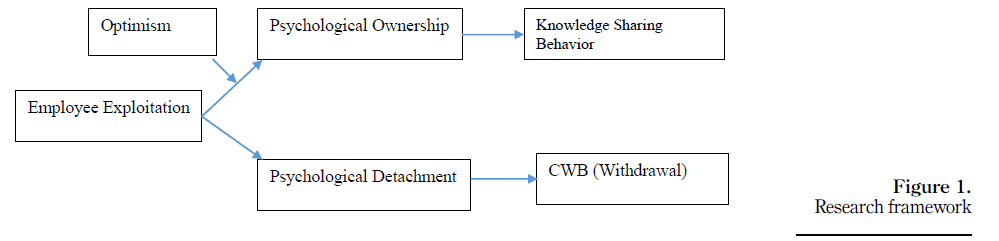
1. Causal Direction is Counter-Intuitive: Exploitation is overwhelmingly associated with negative emotional and attitudinal outcomes (resentment, distrust, alienation). Psychological Ownership (PO), conversely, is a positive, high-involvement state. Proposing that a negative stressor (exploitation) leads to a positive, engagement-like state (PO) requires an exceptionally strong and well-articulated theoretical mechanism, such as defensive coping or compensatory efforts (e.g., "I'm being exploited, but I'll seize control/ownership over my work to compensate").
2. Contradiction of Foundational Theory (Social Exchange): The model fundamentally challenges Social Exchange Theory (SET), which would predict that the employee's poor treatment (Exploitation) leads to a negative reciprocal response, such as Reduced Psychological Ownership and subsequent Knowledge Hiding (the opposite of sharing). While challenging theory is good, an insufficient or weak theoretical justification for the positive link is a major flaw.
3. The Ambiguous Role of Optimism: The abstract notes the study tested Optimism as a moderator on the Exploitation → Psychological Ownership path, but the results reportedly suggested an insignificant moderating role. If optimism (a primary coping resource) does not significantly condition this link, it casts even more doubt on how a positive relationship (β = 0.418, p < 0.024, p. 1218) could exist or be explained, especially in a population of highly qualified employees.
Since the study relies on cross-sectional survey data (a common method in this field), several inherent methodological limitations likely apply:
1. Common Method Bias (CMB): The study used a self-administered questionnaire where all variables (Exploitation, Psychological Ownership, Detachment, Knowledge Sharing, CWB, and Optimism) were reported by the same respondent at the same time. This inflates correlations, making it easier to find significant paths, and severely limits the ability to draw causal conclusions. The authors should have used a rigorous time-lagged design or multi-source data to address this issue. Unfortunately, no details were given about how the CMB was addressed.
2. Causal Inference Problem: A cross-sectional design cannot establish temporal precedence—a core requirement for causality and mediation. The data cannot confirm that Exploitation occurred before Ownership, or that Ownership occurred before Knowledge Sharing. An alternative model (e.g., Low Knowledge Sharing leads to Perceived Exploitation) is equally plausible based on the data structure.
3. Sample Restriction/Generalizability: The sample was restricted to 255 employees with the highest qualification in public sector organizations. This specific population is not representative of the general workforce. Employees with high qualifications may experience different forms of exploitation (e.g., "career ceiling," "skill underutilization") and react differently than blue-collar or lower-skilled workers. The findings may, therefore, have extremely limited external validity.
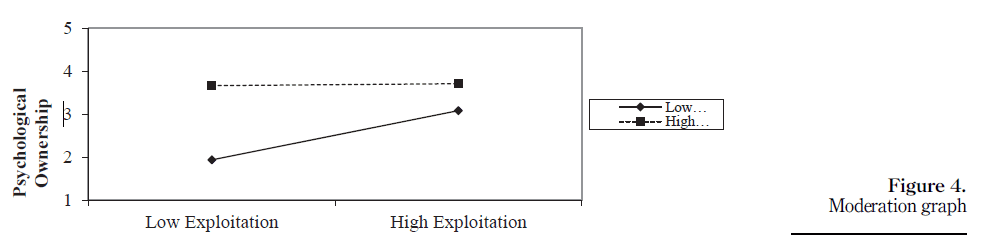
4. Misleading Moderation Plot: On p. 1220, the authors confirmed that the effect of exploitation * optimism (interaction) on psychological ownership is insignificant (B = -0.103; t = -0.939; CI = -0.367 – 0.118). Similarly, on page 1219, the authors mention “Figure 4 (moderation graph) revealed that moderators have no impact on psychological ownership development.” We can see that the presented moderation graph (Figure 4) shows “antagonistic type moderation” which means that the low level of Moderator enables the positive effect of the IV on the DV. The presented moderation graph contradicts the statistical findings that there is no moderation.
1. Vague Operationalization of Exploitation: The Literature Review suggests Exploitation was operationalized narrowly as a tendency "where career progression of an employee may be stopped due to strict and vague policies (p. 1209)." While this is a form of exploitation, it is much narrower than the concept's theoretical scope (which includes unfair wages, overwork, etc.) and may not fully capture the construct, weakening the theoretical connection to emotional states like Psychological Detachment or CWB.
2. Conflicting Findings Reported: The abstract/summary contains contradictory or confusing findings, which is a major red flag for clarity and consistency:
• It states Optimism's moderating role was insignificant (in the relationship between Exploitation and Psychological Ownership, p. 1219).
•It then states Psychological Ownership fully mediates the relationship between Exploitation and Knowledge Sharing (p. 1218).
• This implies a significant and fully mediated effect exists despite the lack of buffering/explaining effect from the key boundary condition (Optimism), making the overall mechanism difficult to trust.
• It is important to note that mean for Exploitation is 3.6409 and for Psychological Ownership is 2.5496. On a 5-point Likert type response format, 3.6409 mean value suggests that the average respondent leans toward Agreement, whereas 2.5496 mean value suggests that the average respondent leans toward Disagreement. If Exploitation positively predicts Psychological Ownership, as found by the study (β = 0.418, p < 0.024, p. 1218), it seems counter-intuitive to get this positive relationship becasue a majority of the respondents indicated that Exploitation leads to low Psychological Ownership.
In summary, the article presents a complex, dual-path model that suffers from a highly questionable causal logic in its positive pathway, compounded by severe limitations inherent in cross-sectional self-report survey methodology. In addition to above-mentioned problems, the study did not provide information about how non-response bias and common method bias were handled. The correlation matrix is missing. Point information about Likert response format is missing. Furthermore, the study shows significant effect of optimism on psychological ownership (B = 0.647*, t = 1.52, see Table 9, p. 1220), but the same result is insignificant as shown in Table 7 (p. 1218) [we wonder how t = 1.52 reflects significance].
As we highlighted some major issues that should not have been published, this shows a complete editorial and peer review failure. We believe this article deserves to be retracted.
Don’t forget to leave you comments if you find this article interesting.
"Scholarly Criticism" is launched to serve as a watchdog on Business Research published in so-called Clarivate/Scopus indexed high quality Business Journals. It has been observed that, currently, this domain is empty and no one is serving to keep authors and publishers of journals on the right track who are conducting and publishing erroneous Business Research. To fill this gap, our organization serves as a key stakeholder of Business Research Publishing activities.
For invited lectures, trainings, interviews, and seminars, "Scholarly Criticism" can be contacted at Attention-Required@proton.me
Disclaimer: The content published on this website is for educational and informational purposes only. We are not against authors or journals but we only strive to highlight unethical and unscientific research reporting and publishing practices. We hope our efforts will significantly contribute to improving the quality control applied by Business Journals.