Published on: 14 June, 2026
The Academy of Management Journal (AMJ) Management Research Canvas (Dorobantu et al., 2024) provides a structured heuristic for aligning the disparate elements of empirical inquiry. However, we argue that the tool's utility is bounded by specific ontological and epistemological assumptions. By analyzing the Canvas through the lenses of abductive reasoning, institutional isomorphism, and epistemic injustice, we demonstrate how its modular architecture may inadvertently incentivize incrementalism, marginalize non-Western knowledge systems, and privilege "template sensemaking" over substantive theoretical innovation. We call for an open-architecture approach to research design that preserves the non-linearity essential for breakthrough discoveries.
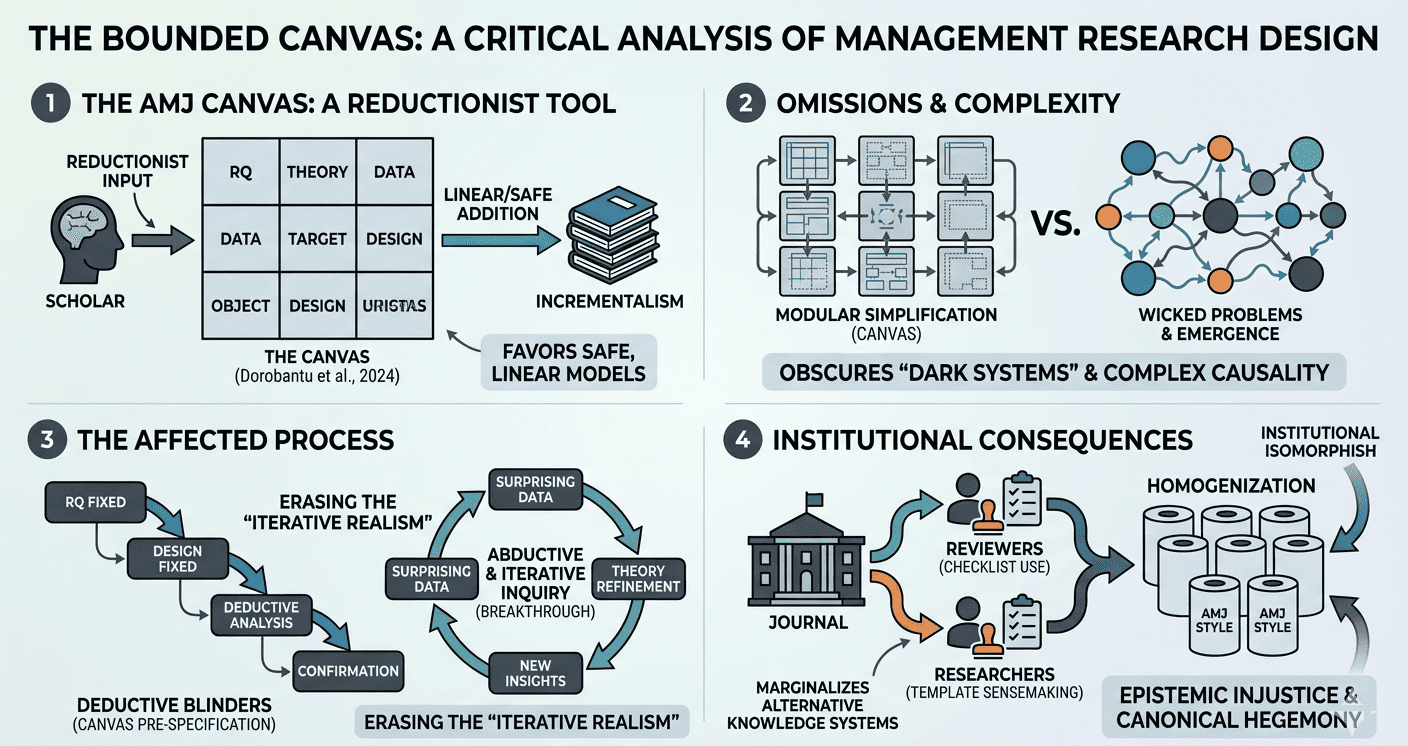
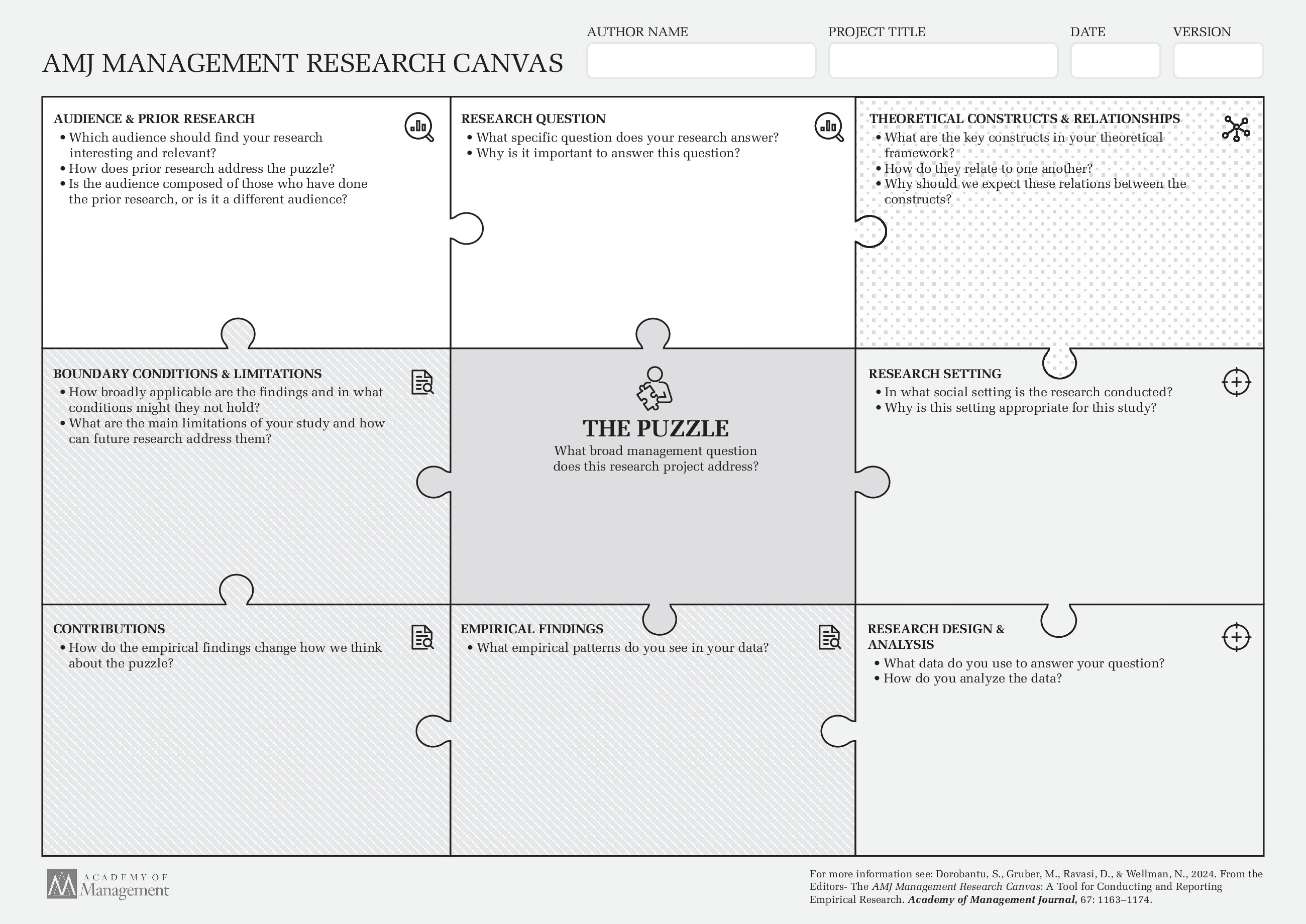
The AMJ Management Research Canvas (Dorobantu et al., 2024) is a timely response to the increasing complexity of organizational scholarship. By distilling the research process into nine interlocking “boxes,” it offers a clear cognitive map for navigating the “puzzle” of empirical work. Yet, as Alfred Korzybski famously noted, “the map is not the territory.” While the Canvas succeeds as a communicative device, its adoption as a generative design tool introduces significant technical risks. Epistemology serves as the backbone of the scientific method, defining what qualifies as evidence and how that evidence is interpreted (Lara-Haro, 2026). When this backbone is preset into a standardized grid, we risk prioritizing the aesthetic of rigor over the substance of discovery.
The primary technical boundary of the Canvas is its inherent bias toward deductive reasoning. Breakthrough management research often relies on abduction—a process where the researcher moves iteratively between surprising data and theoretical refinement (Miller et al., 2025).
By requiring researchers to define “Theoretical Contribution” and “Research Question” in discrete boxes at the outset, the Canvas creates a psychological “lock-in” effect. This discourages the “productive failure” where a study’s initial premise is abandoned in favor of a more profound, emergent discovery.
Standardized templates can lead to epistemic closure, where the boundaries of what is “knowable” are defined by the boxes of the template (Adams, 2026). In complex organizational environments, the most impactful insights often lie in the spaces between the boxes—areas the Canvas, by its modular nature, is ill-equipped to capture.
Management phenomena are frequently “wicked problems” characterized by circular causality and emergence. The Canvas, however, is a reductionist instrument that assumes an organizational whole can be understood by summing its modular parts (Minati, 2023).
The Canvas treats “Research Design” and “Theoretical Constructs” as independent modules (Dorobantu et al., 2024). In high-level scholarship, however, the method is constitutive; it shapes the reality being observed (Lara-Haro, 2026).
By forcing non-linear causal paths into a 2D grid, the Canvas may obscure “dark systems”—the opaque, non-linear interactions that drive organizational behavior but defy simple categorization (Minati, 2023). This reductionism favors safe, linear models that are easily mapped but may lack real-world validity.
Perhaps the most significant boundary condition of the Canvas is its potential to enact Epistemic Injustice. Scholarship is not a neutral endeavor; it is embedded in socio-historical contexts (Babalola & Nwanzu, 2021).
The Canvas is a product of North American functionalism. For scholars in the Global South or those utilizing indigenous, feminist, or post-colonial methodologies, the Canvas’s requirements (e.g., discrete variables, managerial implications) may be fundamentally incompatible with their ontological foundations.
When a premier journal like AMJ promotes a singular “canonical” tool, it inadvertently signals that research not conforming to this structure is “sub-standard.” This form of “epistemic violence” silences alternative ways of knowing that prioritize holistic, community-based, or non-teleological insights (Babalola & Nwanzu, 2021).
The introduction of the Canvas by journal editors triggers normative and mimetic isomorphism (Guil Gorostidi & Rubio-Arostegui, 2026; Pirrolas, 2025).
There is a high risk that reviewers will use the Canvas as a de facto checklist. Researchers, in turn, will engage in template sensemaking—designing studies to fit the boxes rather than to solve the problem.
This leads to a state where papers formally comply with the “AMJ style” but are substantively decoupled from true rigor (Guil Gorostidi & Rubio-Arostegui, 2026). The result is a homogenization of the field, where safe, incremental additions to existing theory become the only viable path to publication.
We do not suggest the total rejection of the Canvas, but rather its relegation to a secondary status. It should be viewed as a post-hoc reporting aid, not a pre-hoc design mandate. To foster truly “Big Theory,” the Academy must protect the “messy realism” of discovery. We must ensure that our tools facilitate thought rather than replace it. The future of management science depends on our ability to think outside the boxes, even those provided by our most respected journals.
Adams, J. (2026). Open at the level of (para)text: Critical intertextuality and discursive notation as open research practices in the humanities. Journal of Electronic Publishing. 29(1), 57-82.
Babalola, S. S. & Nwanzu, C. L. (2021). The current phase of social sciences research: A thematic overview of the literature. Cogent Social Sciences, 7(1). https://doi.org/10.1080/23311886.2021.1892263
Dorobantu, S., Gruber, M., & Ravasi, D. (2024). The AMJ Management Research Canvas: A tool for conducting and reporting empirical research. Academy of Management Journal, 67(6). https://doi.org/10.5465/amj.2024.4005
Guil Gorostidi, S.C. & Rubio-Arostegui, J.A. (2026). Quality management in higher education from the perspective of institutional isomorphism: A scoping review. Frontiers in Education. https://doi.org/10.3389/feduc.2025.1720224
Lara-Haro, D., Haro-Sarango, A., López-Fraga, P., & Esquivel-Valverde, A. (2026). Research with Epistemology: Are we really following the scientific method? Publications, 14(1), 18. https://doi.org/10.3390/publications14010018
Miller, C.C, Chattopadhyay, P., Bamberger, P., & Rockmann, K. (2025). Leveraging empirical abduction to bridge the rigor–relevance divide: Celebrating 10 years of Academy of Management Discoveries. Academy of Management Discoveries, 11(3), 325–331. Available at: https://doi.org/10.5465/amd.2025.0239
Minati, G. (2023). Theoretical reflections on reductionism and systemic research issues: Dark systems and systemic domains. Systems, 12(1), 2. https://doi.org/10.3390/systems12010002
Pirrolas, O. A. C. & Correia, P. M. A. R. (2025). From isomorphism to institutional work: The advancement of institutional theory in public administration. Encyclopedia, 5(4), 184. https://doi.org/10.3390/encyclopedia5040184
"Scholarly Criticism" is launched to serve as a watchdog on Business Research published in so-called Clarivate/Scopus indexed high quality Business Journals. It has been observed that, currently, this domain is empty and no one is serving to keep authors and publishers of journals on the right track who are conducting and publishing erroneous Business Research. To fill this gap, our organization serves as a key stakeholder of Business Research Publishing activities.
For invited lectures, trainings, interviews, and seminars, "Scholarly Criticism" can be contacted at Attention-Required@proton.me
Disclaimer: The content published on this website is for educational and informational purposes only. We are not against authors or journals but we only strive to highlight unethical and unscientific research reporting and publishing practices. We hope our efforts will significantly contribute to improving the quality control applied by Business Journals.