Published on: 20 August, 2026
A bibliometric review of the article titled “Crowdshipping for last-mile delivery in the sharing economy and crowdsourced quick commerce" by Shahryar Sorooshian (published in The TQM Journal, Vol. 38 No. 11, 2026) reveals several severe methodological flaws, structural contradictions, logical discrepancies, and integrity concerns. These issues provide a robust foundation for a formal request for retraction.
The TQM journal is indexed/abstracted/listed in Clarivate’s ESCI (IF 2025: 4.4), Scopus (Q1), Cabell's Directory, ABDC etc.
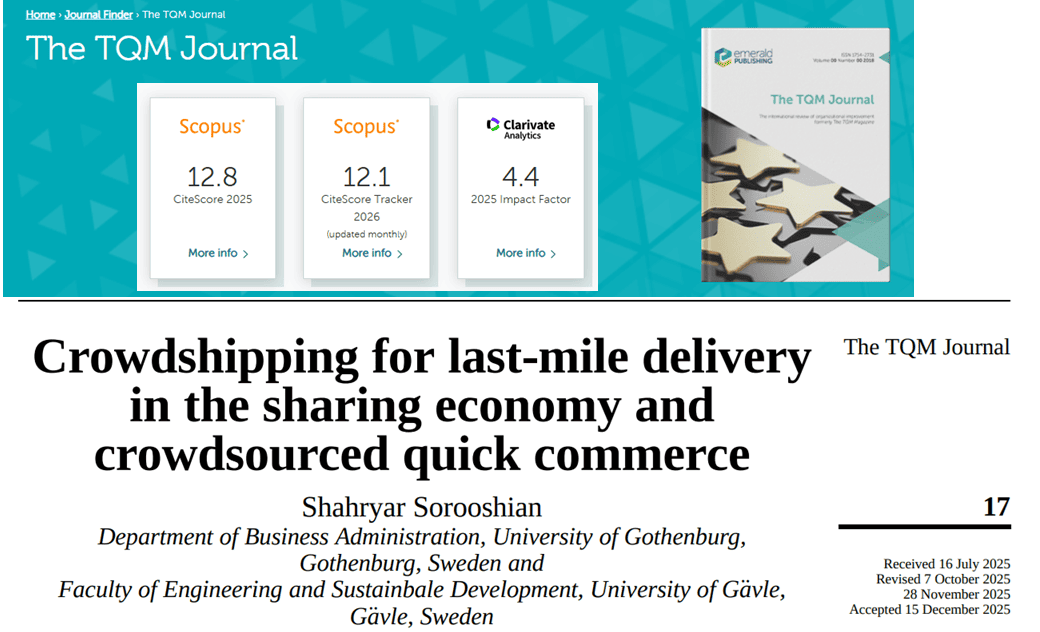
The paper exhibits severe timeline anomalies regarding data collection and publication dates. The manuscript specifies on page no. 21 that the Scopus database search was executed on May 8, 2025. However, the reference list and main text contain citations to journal articles bearing official publication dates “after” this search date. We identified that following studies included in the review were published after May 8, 2025:
1. Factors influencing couriers’ acceptance of crowdsourcing in last-mile delivery in Saudi Arabia (Alromema et al., 2025). The article was accepted on 11 August 2025 and published on 15 September 2025.
We wonder how a study that was published on 15 September 2025, was indexed by Scopus before 8 May 2025.
2. Investigating Opportunities in Crowd-Shipping by Parcel Receivers: A Behavioural Analysis (Mohri et al., 2025). The article was accepted on 9 May 2025 and become available online on 13 May 2025.
Strangely, the author found this study in Scopus 6 day before it was actually published in the journal.
3. Strategic insights into last-mile delivery: modelling the industry 4.0 enabler for e-commerce industry (Sharma et al., 2025 ). The article was accepted on 9 March 2025 and published on 19 May 2025.
4. Joint Matching and Pricing for Crowd-shipping with In-store Customers (Dehghan et al., 2025). The article was submitted to arXiv on 2 July 2025. The article was later published in “INFOR: Information Systems and Operational Research”, a journal published by Taylor & Francis, on 22 April 2026 (received on 4 December 2025).
We wonder how this article appeared in Scopus as it does not index articles available on arXiv which is an open-access preprint server.
Furthermore, the paper itself is officially designated as Vol. 38 No. 11, 2026, with an acceptance date of December 15, 2025. A bibliometric study claiming to capture a snapshot of literature up to May 8, 2025, cannot logically incorporate data, articles, and volumes dated well after May 8, 2025 unless retroactive or falsified data inclusion methods were utilized. This undermines the reproducibility and empirical validity of the entire bibliometric mapping. It should be noted that above mentioned articles are not shown in Table 1 (p. 25). Citing these articles in the text demonstrates that the author was actively reading and inserting post-May 2025 literature during the drafting or peer-review revision phases. Yet, because these papers were missing from Table 1, it highlights that the author never updated the actual bibliometric search parameters or data frame. The author used newer papers to pad the introduction or discussion text, while leaving the underlying data set frozen at a fictional cutoff date—or worse, demonstrating a careless, unorganized reference management process.
In a standard bibliometric review, the papers subjected to the bibliometric analysis should form the core foundation of what is discussed, mapped, and evaluated. If the author is citing references in the text that were never captured or intentionally omitted from the core Table 1 dataset, it creates a severe structural fracture. It proves that the literature review is operating on two unaligned tracks: a narrative literature review using arbitrary recent papers, and a restricted, static Scopus dataset (the 75 documents). Mixing haphazardly chosen external papers into the text while claiming the insights stem strictly from a systematic bibliometric mapping violates the baseline protocols of a systematic review.
In Section 3 (Methodology), the author states that the initial Scopus search yielded 300 records across 16 subject areas (p. 21). The author then explicitly filters these records to focus solely on the subject area of “Business, Management, and Accounting," resulting in a finalized dataset of 75 documents (p. 21).
In Section 4.1, the author breaks down these 75 documents by publication type: “Scopus classified 67 of these 75 documents as research articles, four as conference papers, two as book chapters, and two as literature reviews. (p. 22)” However, in the very same section, the author analyzes the annual distribution (Figure 2) and states that the initial 2017 cohort consisted of “six documents: one conference paper and five research articles” produced entirely by researchers from North America and Western Europe.
Cross-checking the methodology with standard Scopus database behavior reveals that conference papers, book chapters, and certain reviews are frequently indexed under Engineering, Computer Science, or Decision Sciences rather than strictly Business, Management, and Accounting. Filtering strictly by a single primary subject area code typically purges cross-disciplinary conference items unless manual overrides occurred without disclosure. More importantly, the inclusion criteria fail to transparently address how engineering-heavy optimization papers (which dominate the citation list, such as vehicle routing algorithms, operations research studies) made it past a strict “Business, Management, and Accounting” filter. Without a transparent explanation, the reproducibility of the dataset is compromised.
The manuscript relies heavily on self-citations to validate its methodological choices and theoretical framework. The author cites their own peripheral work (Sorooshian, 2024; Sorooshian et al., 2022; Sorooshian et al., 2023a; Sorooshian et al., 2023b; Tavana and Sorooshian, 2023) to justify basic bibliometric practices, software usage, and structural frameworks. While self-citation is not inherently grounds for retraction, an over-reliance on self-referential benchmarks to validate an isolated database slice creates academic echo chambers and inflates citation metrics artificially, violating objective standards of systematic literature reviews.
In Section 3, the author explicitly transparently admits: "To achieve this, we used Scopus analytics tools, ChatGPT (https://chatgpt.com/) artificial intelligence version o4-mini-high, and ScienceSpace (...) to interpret the data." (p.22).
Relying on “black-box” generative AI models (like ChatGPT) to “interpret” data and synthesize qualitative literature streams introduces unquantifiable hallucination risks, lack of auditability, and non-replicable qualitative coding. Systematic reviews require rigorous, transparent human-coded thematic analysis; delegating data interpretation to a conversational LLM compromises the scientific integrity of the findings. Delegating the qualitative interpretation, coding, and structural synthesis of literature streams to a black-box conversational LLM introduces severe reproducibility issues. Because LLM outputs are stochastic and non-deterministic (meaning the exact same prompt yields different thematic clusters on different runs), no independent researcher can replicate or verify the core findings, classification of research streams, or the derivation of the “LMD Strategy Canvas.” This directly violates data auditability and qualitative research transparency standards.
Emerald Publishing maintains explicit governance frameworks regarding the use of Artificial Intelligence and Large Language Models (LLMs) in research. While Emerald permits generative AI for minor text polishing, copy-editing, or structuring assistance under strict transparency guidelines, its policy mandates that AI tools must not replace core human involvement in data analysis, interpretation, or conceptual design.
By explicitly stating that ChatGPT (version “o4-mini-high”) and ScienceSpace were utilized to interpret the data (p. 22), the author crosses the boundary from using AI as an auxiliary writing or formatting aid to outsourcing the primary analytical synthesis and qualitative coding to a black-box model. This direct admission conflicts with publisher directives regarding human accountability for the intellectual and analytical integrity of published works.
Throughout the text, there is a fundamental contradiction regarding the maturity of the field.
In Section 4.3, the author explicitly states: "75 indexed documents in nearly ten years do not represent a mature area of knowledge... (p. 26)".
Yet, throughout Section 4.2 (p. 23) and the development of the “LMD Strategy Canvas” (p. 26), the author treats the literature as mature enough to construct exhaustive taxonomies, rigid operational optimization streams, and definitive managerial decision frameworks.
The TQM Journal explicitly mandates that contributions cover theoretical developments or practical applications of the “hard” and “soft” aspects of TQM, addressing specific topics such as quality measurement, costs of quality, continuous improvement, ISO standards, excellence models, Six Sigma, Lean, or quality control tools.
Sorooshian’s article is a bibliometric mapping of crowdshipping, quick commerce, and last-mile logistics networks. The manuscript contains zero substantive discussion, measurement, or integration of total quality management principles. It never examines service quality metrics, error rates in delivery fulfillment from a quality assurance perspective, process capability, or quality control frameworks. It reads purely as a supply chain, transportation, and logistics paper.
While the journal welcomes research on the 4th Industrial Revolution, AI, and smart technologies, its scope strictly requires that these technologies be evaluated regarding their impact on quality management, manufacturing/service processes, or customer experience improvement in specific sectors like retail or hospitality. The article touches upon technology platforms, blockchain, and AI (specifically noting the use of ChatGPT for data interpretation). These technologies are discussed entirely through the lens of algorithmic route optimization, vehicle routing problem (VRP) heuristics, pricing games, and platform business models—not as mechanisms for quality enhancement, process control, or defect reduction.
The TQM Contributors are explicitly directed to focus their work on advancing the "body of knowledge on quality management." The article focuses exclusively on advancing the literature stream of crowdshipping and sharing economy logistics. By positioning its primary contribution as mapping crowdshipping business models, operational routing algorithms, and a “Last-Mile Delivery (LMD) Strategy Canvas,” the paper contributes to transport economics and logistics literature rather than quality management theory or practice. Publishing a paper devoid of quality management constructs in a specialized quality journal represents a clear breach of scope alignment.
The article suffers from fatal temporal inconsistencies (citing articles published after 8 May 2025), opaque methodology regarding subject-area filtration, an over-reliance on unverified generative AI models for data interpretation which is prohibited by Emerald, and out of scope content. These elements collectively invalidate the bibliometric findings and render the paper unfit for scholarly record.
This article reflects a complete failure of editors and publisher's policies regarding AI use.
Don’t forget to leave comment if you find this article interesting.
"Scholarly Criticism" is launched to serve as a watchdog on Business Research published in so-called Clarivate/Scopus indexed high quality Business Journals. It has been observed that, currently, this domain is empty and no one is serving to keep authors and publishers of journals on the right track who are conducting and publishing erroneous Business Research. To fill this gap, our organization serves as a key stakeholder of Business Research Publishing activities.
For invited lectures, trainings, interviews, and seminars, "Scholarly Criticism" can be contacted at Attention-Required@proton.me
Disclaimer: The content published on this website is for educational and informational purposes only. We are not against authors or journals but we only strive to highlight unethical and unscientific research reporting and publishing practices. We hope our efforts will significantly contribute to improving the quality control applied by Business Journals.